
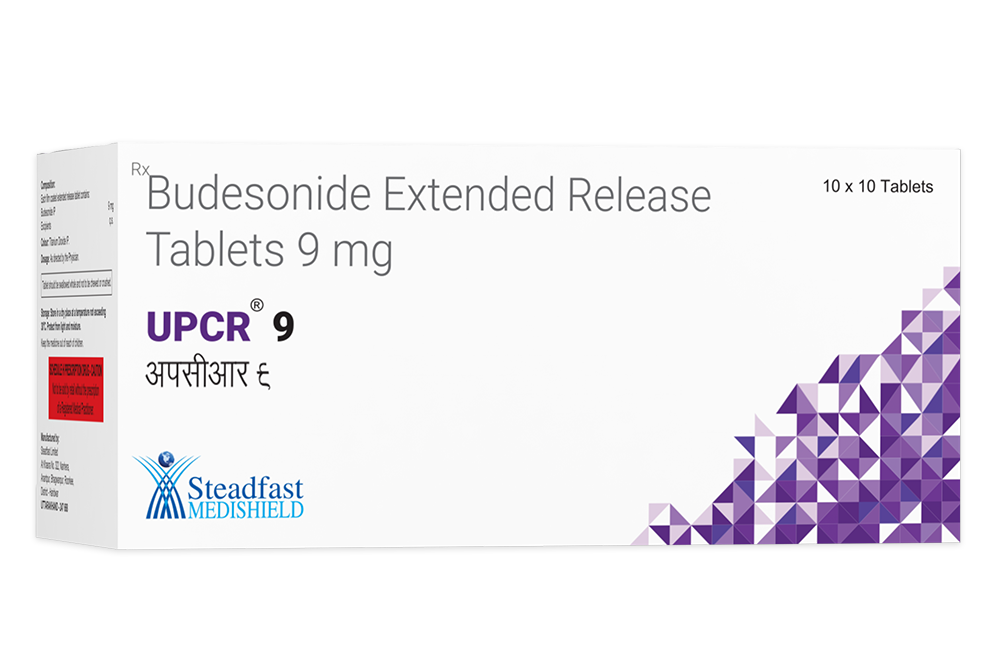
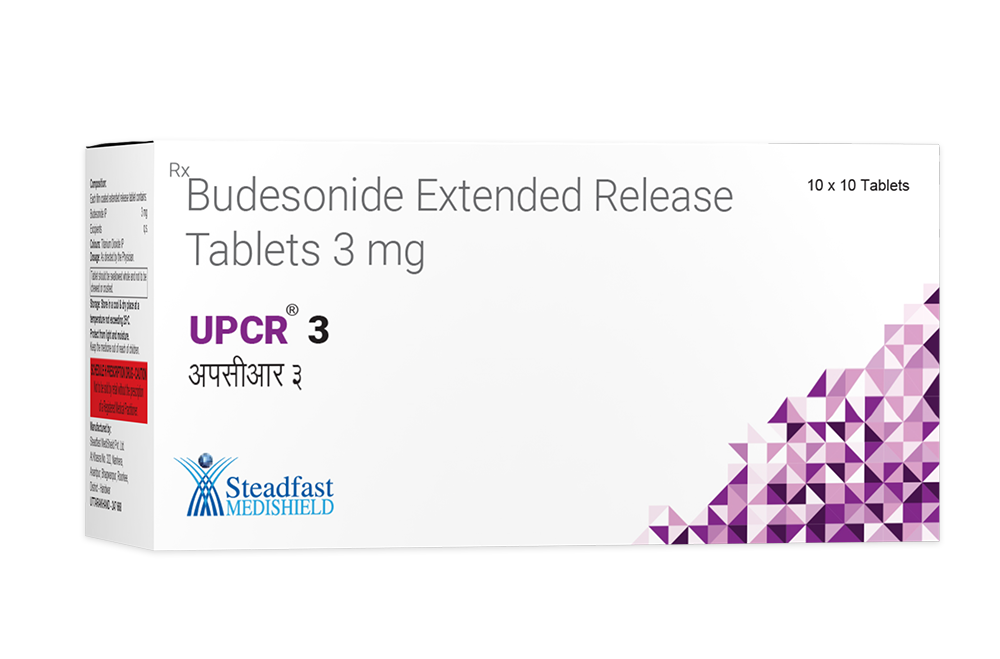
UPCR (Budesonide) is a corticosteroid with high first-pass hepatic metabolism, limiting systemic exposure. In extended-release form it delivers targeted action to the distal ileum and proximal colon — aligning with the gut-associated lymphoid tissue (GALT), the suspected site of IgA immune dysregulation. It is formulated to release budesonide specifically in the distal ileum, targeting Peyer’s patches, which are rich in the B cells implicated in IgA nephropathy (IgAN) pathogenesis. UPCR uses a pH- and time-dependent coating to ensure drug release in the targeted intestinal region, maximising local immunosuppressive effect while minimising systemic exposure through high first-pass metabolism.
Composition
Each film-coated extended-release tablet contains Budesonide IP 3 mg or 9 mg, with excipients q.s.
Pharmacology
Drug Class: Corticosteroid.
- Budesonide is an anti-inflammatory corticosteroid with potent glucocorticoid activity and weak mineralocorticoid activity.
- It targets GALT, especially the Peyer’s patches of the distal ileum, to modulate mucosal immune responses driving IgA nephropathy.
- Mucosal B-cells in the ileum (including Peyer’s patches) express glucocorticoid receptors and are responsible for production of galactose-deficient IgA1 antibodies implicated in IgAN.
- Corticosteroids modulate B-cell numbers and activity through anti-inflammatory and immunosuppressive effects.
Pharmacokinetics
- Absorption: oral bioavailability ~10–12%, due to extensive first-pass metabolism.
- Distribution: ~85–90% protein bound, mainly to plasma albumin.
- Metabolism: extensive hepatic first-pass metabolism, primarily via CYP3A4.
- Elimination: half-life 2–4 hours; excreted in urine (60%, unchanged) with minimal faecal excretion; major metabolites (16α-hydroxyprednisolone and 6β-hydroxybudesonide) are mainly renally excreted, intact or conjugated.
Indications
- Treatment of primary IgA nephropathy (IgAN) with proteinuria ≥1 g/day, in patients at risk of disease progression.
- In patients with eGFR ≥35 mL/min/1.73 m².
- Indicated to reduce loss of kidney function in adults with primary IgAN who are at risk of disease progression.
Clinical Efficacy
NEFIGAN trial (Phase 2b, randomised, double-blind, placebo-controlled; n=150; proteinuria 0.75–2 g/day, eGFR >45 mL/min/1.73 m²): targeted-release budesonide at 16 mg/day (induction), titrated to 9 mg/day for most patients over 9 months, produced a 23–27% reduction in proteinuria with no decline in eGFR and fewer systemic corticosteroid-related effects.
NefIgArd trial (Phase 3, global, double-blind, placebo-controlled, with open-label extension; n=364; proteinuria ≥1 g/day on optimised RAS blockade): 9 mg once daily (morning) for 9 months (double-blind) plus a 15-month open-label extension produced a significant 27% proteinuria reduction at 9 months versus placebo, preserved eGFR over 2 years, and mild corticosteroid effects with no increased serious infection risk.
Contraindications
Documented hypersensitivity to budesonide or any excipient.
Precautions
- Use cautiously in patients with hypertension, diabetes mellitus, osteoporosis, peptic ulcer, hepatic impairment, glaucoma, or cataract.
- Monitor urine protein-to-creatinine ratio (UPCR) and eGFR regularly.
- Risk of adrenal suppression with chronic use; tapering may be required on discontinuation.
- Immunosuppression risk — monitor for infections.
- Pregnancy: available studies have not identified a drug-associated risk. Lactation: no lactation studies conducted; no information available on effects on infants or milk production.
Adverse Effects
- Common: peripheral oedema, headache, hypertension, muscle spasms, acne.
- Less common: dermatitis, dyspnoea, facial oedema, dyspepsia, fatigue, hirsutism.
- Rare: weight gain, adrenal suppression, mood disturbances, glucose intolerance, increased infection risk.
Drug Interactions
- Strong CYP3A4 inhibitors (ketoconazole, itraconazole, voriconazole; macrolides such as clarithromycin/erythromycin; ritonavir; grapefruit juice; cobicistat): can significantly increase systemic budesonide exposure via reduced first-pass metabolism. Avoid use or monitor closely.
- CYP3A4 inducers (rifampin, carbamazepine, phenytoin, St. John’s Wort): reduce budesonide efficacy by enhancing metabolism/clearance.
- Immunosuppressants/other corticosteroids: use cautiously due to increased risk of infection, impaired wound healing, and adrenal suppression.
- Live vaccines: corticosteroid-induced immunosuppression can interfere with vaccine efficacy and safety — avoid concurrent use.
Overdosage
Acute overdosage with budesonide is unlikely to require emergency intervention. Chronic overdosage or supratherapeutic dosing may lead to features of hypercorticism, including adrenal suppression and Cushingoid features. Management is symptomatic and supportive, with gradual dose tapering as appropriate; there is no specific antidote.
Dosage and Administration
Route: Oral. Dosage: as directed by a physician.
- Usual daily dosage: 9 mg (as 1 × 9 mg or 3 × 3 mg tablet), once daily in the morning, at least 1 hour before food.
- Therapy duration: 9 months.
- Maximum daily dosage: 16 mg orally once daily.
- When discontinuing, reduce to 8 mg orally once daily for the final 2 weeks of therapy.
- Safety and efficacy of subsequent treatment courses have not been established.
Administration: swallow whole with water; do not crush or chew. Avoid grapefruit juice (CYP3A4 interaction).
Storage
Store in a cool, dry place at a temperature not exceeding 25°C. Protect from light and moisture.
Presentation
10×10 tablets per box (1 strip = 10 tablets; 10 strips per box) — available as UPCR 3 and UPCR 9.