
For the use of a Registered Medical Practitioner, Hospital or Laboratory only.
1. Description
MultiBac sachet contains Fosfomycin Trometamol 3 g, a broad-spectrum bactericidal antibiotic belonging to the phosphonic acid derivative class. It inhibits the early stage of bacterial cell wall synthesis.
Fosfomycin Trometamol Powder for Oral Solution
2. Composition
Fosfomycin Trometamol 3 g
Each sachet contains Fosfomycin Trometamol BP equivalent to Fosfomycin 3.0 g, with excipients q.s.
3. Dosage Form
Powder (for oral solution)
4. Pharmacology
Drug Class: Antibiotic (phosphonic acid derivative).
Fosfomycin exerts a bactericidal effect on proliferating pathogens by preventing enzymatic synthesis of the bacterial cell wall. It inhibits the first stage of intracellular bacterial cell wall synthesis by blocking peptidoglycan synthesis:
- Inhibition of cell wall synthesis: the bacterial cell wall, composed of peptidoglycan, provides structural support and maintains cell integrity.
- Inhibition of enzymes: fosfomycin enters bacterial cells and inhibits the enzyme MurA, essential for early peptidoglycan formation.
- Weakening of the cell wall: without proper peptidoglycan formation, the cell wall becomes structurally unstable.
- Cell lysis and death: the resulting internal pressure imbalance causes the bacterial cell to rupture.
Pharmacodynamics
Fosfomycin is a bactericidal, broad-spectrum antibiotic that inhibits bacterial cell wall synthesis at an early stage.
It enters bacterial cells through glycerophosphate (GlpT) and hexose phosphate (UhpT) transport systems. Inside the bacterial cell, fosfomycin irreversibly inhibits the enzyme UDP-N-acetylglucosamine enolpyruvyl transferase (MurA).
MurA catalyzes the first committed step in peptidoglycan synthesis. Inhibition of this enzyme prevents formation of N-acetylmuramic acid, an essential precursor of the bacterial cell wall, leading to bacterial cell lysis and death.
Fosfomycin exhibits concentration-dependent bactericidal activity against many Gram-positive and Gram-negative organisms, including susceptible strains of:
Escherichia coli
Klebsiella spp.
Proteus spp.
Enterococcus faecalis
Staphylococcus aureus (including some MRSA strains)
Pseudomonas aeruginosa (mainly with intravenous therapy)
Its distinct mechanism of action results in minimal cross-resistance with other antibiotic classes, making it useful against multidrug-resistant organisms.
- Broad antimicrobial spectrum, active against both Gram-positive and Gram-negative pathogens.
- Activity against problem organisms including MRSA, VRE, ESBL- and carbapenemase-producing Enterobacterales, and multidrug-resistant Pseudomonas aeruginosa.
- High activity against biofilms; synergistic or additive effects with other antibiotic classes.
- Reno-protective effect when combined with nephrotoxic drugs; clinical resistance to fosfomycin remains low.
Pharmacokinetics
Absorption
Rapidly absorbed following oral administration.
Oral bioavailability is approximately 34–58%.
Peak plasma concentrations are achieved within 2–2.5 hours.
Food delays absorption and may reduce urinary concentrations.
Distribution
Widely distributed to the kidneys, bladder wall, urine, prostate, and other tissues.
Plasma protein binding is negligible (<5%).
Metabolism
Fosfomycin undergoes minimal to no metabolism.
It is excreted largely as unchanged drug.
Elimination
Eliminated primarily by glomerular filtration.
Approximately 38–50% of the oral dose is excreted unchanged in the urine.
Elimination half-life is approximately 4–6 hours in individuals with normal renal function.
Therapeutic urinary concentrations may persist for 24–48 hours, supporting single-dose treatment for uncomplicated urinary tract infections.
5. Indications
MultiBac Sachet is indicated for:
Acute uncomplicated urinary tract infection (acute cystitis) in women caused by susceptible microorganisms.
Asymptomatic bacteriuria in pregnancy (where clinically indicated and in accordance with local guidelines).
Prophylaxis of urinary tract infections associated with transurethral surgical and diagnostic procedures (as recommended by the treating physician).
MultiBac Sachet is indicated for the treatment of acute uncomplicated lower urinary tract infections (acute cystitis) in women aged 18 years and older caused by susceptible Escherichia coli and Enterococcus faecalis.
MultiBac Sachet is not indicated for the treatment of pyelonephritis or perinephric abscess.
To reduce the development of drug-resistant bacteria and maintain effectiveness, MultiBac Sachet should be used only to treat infections proven or strongly suspected to be caused by susceptible bacteria. Culture and susceptibility information should guide therapy where available; in its absence, local epidemiology and susceptibility patterns may inform empiric selection.
6. Contraindications
MultiBac Sachet is contraindicated in patients with:
Hypersensitivity to fosfomycin or any component of the formulation.
Severe renal impairment (creatinine clearance <10 mL/min) or patients undergoing haemodialysis, unless specifically recommended by a physician.
Hereditary fructose intolerance (if the formulation contains sucrose).
Known hypersensitivity to fosfomycin or any excipient.
7. Precautions
May be taken with or without food.
Use with caution in patients with renal impairment.
Prolonged use may result in overgrowth of non-susceptible organisms.
Antibiotic-associated diarrhoea, including Clostridioides difficile-associated diarrhoea, should be considered in patients who develop diarrhoea during or after treatment.
Use during pregnancy and lactation only when clearly indicated.
- Patients with severe kidney disease may require dose adjustment.
- Contains sucrose — a consideration for diabetic patients.
- Only a single dose should be used to treat an episode of acute cystitis.
- Elderly patients may require dose adjustment based on kidney function; paediatric dosing depends on body weight and infection type.
- May be used in pregnant women under medical supervision, where considered safer than some alternative antibiotics.
- No dosage adjustment required in hepatic impairment.
8. Drug Interactions
Patients should avoid taking calcium supplements, antacids, or dairy products within 2–3 hours of the dose, as these may interfere with absorption.
9. Adverse Effects
- Common: mild gastrointestinal upset (nausea or diarrhoea), headache or dizziness, temporary changes in taste, vulvovaginal candidiasis in women.
10. Dosage & Administration
Dissolve the contents of one sachet (3 g) in approximately 90–120 mL of water and consume immediately.
For uncomplicated urinary tract infection: One 3 g sachet as a single oral dose, or as directed by the physician.
May be taken with or without food, preferably at bedtime after emptying the bladder.
Dosage form: Powder for oral solution. Route: Oral, mixed with water.
- Standard adult dosing: one 3 g sachet dissolved in 3–4 ounces (approx. 90–120 mL) of cool water, taken as a single dose, with or without food, preferably at bedtime after emptying the bladder. Do not use hot water.
- Dosing before sleep allows maximum bladder concentration overnight.
- Should be taken orally immediately after dissolution.
11. Overdosage
Symptoms may include: electrolyte disturbances; gastrointestinal disturbances.
There is no specific antidote for fosfomycin overdosage. Management is supportive; fosfomycin is dialysable, and haemodialysis may be considered in cases of significant overdose in patients with renal impairment.
12. Storage
Store in a dry place at a temperature not exceeding 30°C. Protect from light. Keep the medicine out of reach of children.
Additional Information
Additional pharmacokinetic information
- Absorption: rapid oral absorption of the trometamol salt with high bioavailability relative to fosfomycin calcium; achieves high urinary concentrations.
- Distribution: volume of distribution ~0.30 L/kg; negligible plasma protein binding; crosses the placenta with low levels in breast milk.
- Metabolism: not metabolised; no hepatic metabolism or enterohepatic circulation — considered safe in hepatic impairment.
- Elimination: primarily renal (glomerular filtration); approximately 38–50% of an oral dose is excreted unchanged in urine and about 18% in faeces; high urinary concentrations are achieved and sustained for 24–48 hours.
- Half-life: approximately 4–6 hours in healthy adults.
13. Presentation
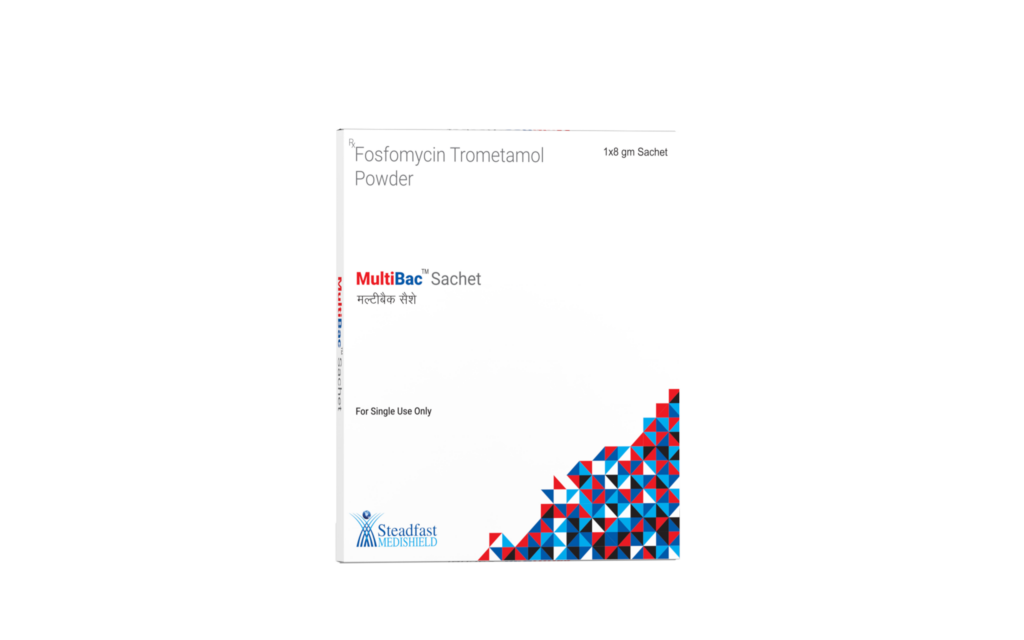
MultiBac Sachet – 1 × 8 g sachet of powder (Fosfomycin Trometamol BP equivalent to Fosfomycin 3.0 g). For single use only.