
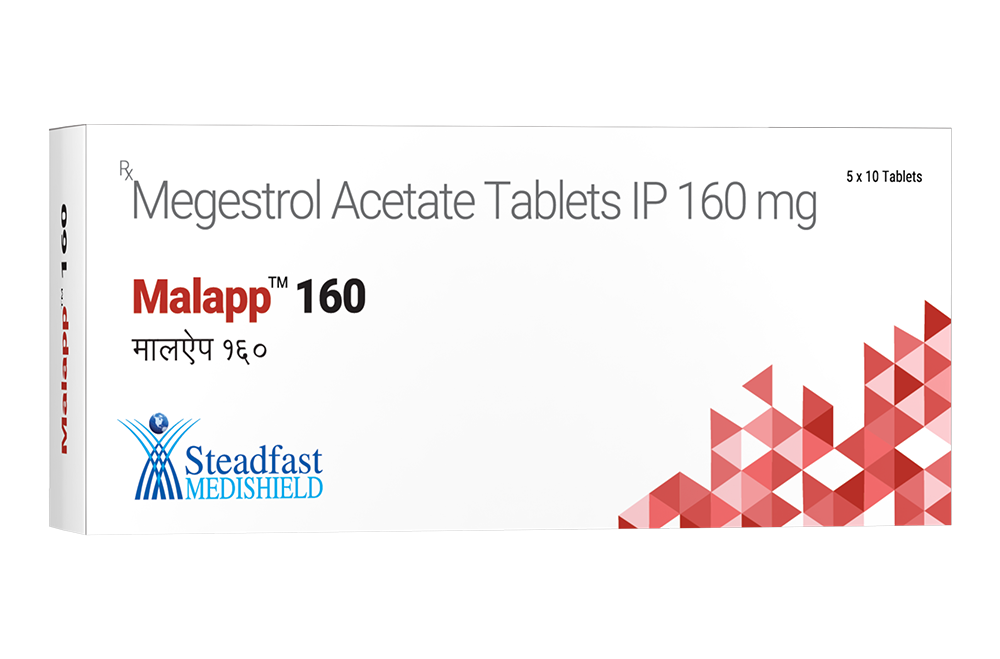
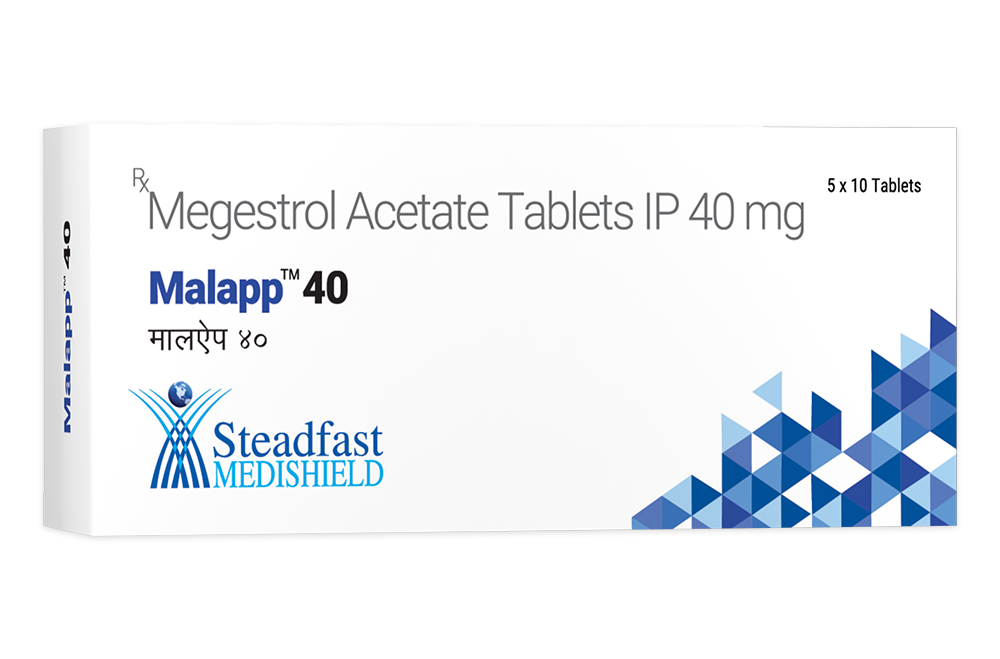
Megestrol acetate is a synthetic progestin used for the management of anorexia, cachexia, and protein-energy wasting (PEW) in patients with chronic kidney disease, particularly those on maintenance dialysis. It acts as an appetite stimulant and has been studied in nephrology for improving nutritional parameters and preserving muscle mass in malnourished dialysis patients. Malapp is formulated for enhanced bioavailability and therapeutic efficacy in renal patients.
Composition
Each uncoated/film-coated tablet contains Megestrol Acetate IP 40 mg or 160 mg, with excipients q.s.
Pharmacology
Drug Class: Progestin (synthetic progestogen; progesterone receptor agonist) with appetite-stimulant and anti-inflammatory properties.
Megestrol acetate is a selective progesterone-receptor agonist that also shows significant glucocorticoid-receptor binding, contributing to its appetite-stimulating and anti-inflammatory effects. In the nephrology setting, its mechanism involves:
- Appetite stimulation via direct central nervous system effects that increase hunger sensation and food intake.
- Anti-inflammatory effects through modulation of inflammatory cytokines (TNF-α, IL-6) that contribute to PEW in CKD.
- Metabolic enhancement — improvement in lean body mass accretion and fat redistribution favouring anabolic processes.
- Anabolic effects — enhancement of protein synthesis and reduction of protein catabolism via glucocorticoid-receptor-mediated pathways.
Pharmacodynamics
- Onset of action: 7–14 days for appetite stimulation; nutritional parameter improvements observed after 4–8 weeks of continuous therapy.
- Peak effects: optimal nutritional benefits typically achieved within 8–12 weeks of treatment.
- Duration: effects persist during continued use; improvement plateaus after 3–6 months with maintenance of achieved nutritional status.
- Reported clinical outcomes in CKD/dialysis patients: serum albumin increase of 0.8–1.1 g/dL within 4–8 weeks; BMI improvement up to 9% over 12 weeks; 27–42% increase in dietary protein intake; reversal of hypoalbuminaemia in selected patients; and preferential gain in fat mass over lean mass, preserving muscle function.
Pharmacokinetics
| Parameter | Detail |
| Absorption | Rapidly absorbed from the GI tract; peak serum levels within 1–3 hours; enhanced absorption with food. |
| Distribution | Widely distributed to body tissues; plasma protein binding 95–98%; crosses the blood–brain barrier. |
| Metabolism | Hepatic, via conjugation and oxidative pathways (primarily CYP3A4); multiple metabolites formed. |
| Elimination | Biliary excretion (primary) and renal elimination of metabolites; half-life 12.7–18.9 hours. |
| Bioavailability | Approximately 30–40% due to extensive first-pass hepatic metabolism. |
| Special populations — CKD | Active drug and metabolites may accumulate in advanced renal disease; dose adjustment recommended for CKD Stage 4–5D (GFR <15 mL/min). |
Indications
- Protein-energy wasting (PEW) in CKD Stage 3–5D, including maintenance haemodialysis and peritoneal dialysis patients.
- Cachexia, anorexia, or unexplained significant weight loss associated with CKD (particularly dialysis), HIV/AIDS, or malignancy (breast, endometrial, prostate cancer — palliative use).
- Adjunctive nutritional support for improving nutritional status and lean body mass where dietary interventions and counselling alone are insufficient.
- Appetite stimulation in patients with chronic disease associated with poor oral intake.
Malapp is most effective in carefully selected patients with documented malnutrition and poor dietary intake; concurrent nutritional counselling and dietary intervention are essential components of comprehensive treatment.
Contraindications
- Known hypersensitivity to megestrol acetate or any excipient.
- Pregnancy — may cause feminisation of male foetuses and increased risk of congenital abnormalities.
- Undiagnosed vaginal bleeding — therapy should not be initiated without prior evaluation.
Precautions
- Serious warnings: increased risk of thromboembolic events; cardiovascular risk; hepatic impairment; endocrine effects; effects on glucose metabolism.
- Medication adherence: effectiveness depends on consistent, regular administration; missed doses reduce clinical benefit.
- Most effective as adjunctive therapy combined with dietary counselling, adequate protein/caloric intake, and regular nutritional assessment; may have limited efficacy if underlying dietary insufficiency is not addressed.
- Limit alcohol consumption — concurrent use may increase GI upset and neurological side effects.
- Counsel patients on smoking cessation, given increased thromboembolic risk with megestrol.
- Pregnancy: contraindicated. Lactation: excreted in breast milk; breastfeeding not recommended during treatment. Counsel women of childbearing potential to use effective (preferably non-hormonal) contraception.
Adverse Effects
- Very common (>10%): weight gain (15–70% incidence, primarily fat mass); increased appetite (desired therapeutic effect); fluid retention and oedema (5–15%).
- Common (1–10%): nausea and vomiting (7–8%); vaginal bleeding in females (7–8%); headache (2–5%); diarrhoea or constipation (2–4%); dizziness or vertigo (2–4%); rash and pruritus (2–3%); flatulence and abdominal discomfort (1–3%).
Drug Interactions
| Drug / Class | Interaction | Management |
| Oral anticoagulants (warfarin) | May increase anticoagulant effect; increased bleeding risk | Monitor INR closely; may require warfarin dose reduction |
| Combined oral contraceptives | May potentiate progestational effects; unpredictable contraceptive efficacy | Use alternative contraception; counsel on increased VTE risk |
| Oestrogen therapy | Synergistic thromboembolism risk; cardiovascular complications | Avoid concurrent use; assess benefit vs risk if essential |
| CYP3A4 inhibitors (ketoconazole, itraconazole, clarithromycin, protease inhibitors) | Decreased metabolism → increased megestrol levels/adverse effects | Monitor for increased side effects; consider dose reduction |
| CYP3A4 inducers (rifampin, carbamazepine, phenytoin, St. John’s Wort) | Increased metabolism → decreased efficacy | May require dose increase; monitor nutritional response |
Overdosage
There is no specific antidote for megestrol acetate overdosage. Management should be symptomatic and supportive, with particular attention to fluid balance, glucose levels, and thromboembolic risk given the drug’s cardiovascular and endocrine effects. In cases of significant overdose, seek prompt medical attention.
Dosage and Administration
Dosage form: Tablets (40 mg and 160 mg strengths). Route: Oral. Dosage: As directed by the physician.
- General CKD/dialysis patients: 160–400 mg daily (80–200 mg twice daily with meals); maximum 400 mg daily in ESRD/CKD Stage 5D. Treatment duration: minimum 8–12 weeks to assess efficacy; may continue up to 6 months for optimal benefit.
- ESRD/maintenance haemodialysis (dose reduction critical): initiate at 160 mg daily; maintenance 160–400 mg daily based on tolerance/response. Do not use the standard 800 mg/day dose in ESRD patients. If intolerable side effects develop, reduce to 40–80 mg daily or discontinue.
- Paediatric CKD patients: 7.5–10 mg/kg/day in 1–2 divided doses; maximum 15 mg/kg/day or 800 mg/day, whichever is lower. Requires close physician monitoring.
Administer with meals to enhance absorption and reduce GI upset, with consistent meal timing. Tablets should be swallowed whole with water; do not crush, chew, or divide.
Storage
Store at room temperature, in a cool, dry, dark place. Protect from light and moisture. Keep out of reach of children.
Presentation
Blister pack of 10×5 tablets (Malapp 40 and Malapp 160).