
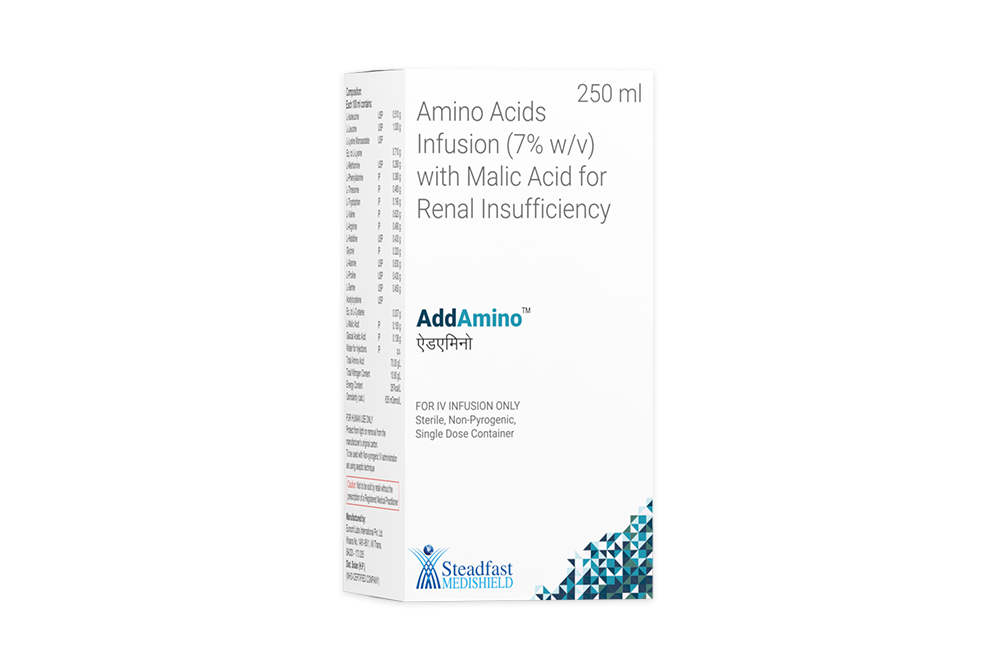
AddAmino is a clear, sterile, non-pyrogenic injection containing a well-balanced mixture of essential and non-essential amino acids, along with malic acid, which plays a role in energy production and metabolic support. It is prescribed to treat nutritional deficiencies where the enteral route (oral, sublingual/buccal, or rectal) is inadequate, inadvisable, or not possible, and is specifically formulated for the nutritional and metabolic needs of patients with renal insufficiency.
Composition
Each 100 ml contains: L-Isoleucine USP 0.510 g, L-Leucine USP 1.030 g, L-Lysine Monoacetate USP (eq. to L-Lysine 0.710 g), L-Methionine USP 0.280 g, L-Phenylalanine IP 0.380 g, L-Threonine IP 0.480 g, L-Tryptophan IP 0.190 g, L-Valine IP 0.620 g, L-Arginine IP 0.490 g, L-Histidine USP 0.430 g, Glycine IP 0.320 g, L-Alanine IP 0.630 g, L-Proline USP 0.430 g, L-Serine USP 0.450 g, Acetylcysteine USP (eq. to L-Cysteine 0.037 g), L-Malic Acid IP 0.150 g, Glacial Acetic Acid IP 0.138 g, Water for Injections IP q.s. Total Amino Acid 70.00 g/L; Total Nitrogen Content 10.80 g/L; Energy Content 287 kcal/L; Osmolarity (calc.) 635 mOsmol/L.
Pharmacology
Drug Class: Nutritional Supplement (Parenteral Amino Acid Infusion).
In patients with renal insufficiency, protein metabolism is altered by decreased glomerular filtration rate, impaired nitrogen excretion, and increased catabolism. AddAmino replenishes substrates for protein synthesis, improves nitrogen balance, and counteracts protein-energy wasting (PEW) with a balanced formulation of essential and non-essential amino acids.
Pharmacodynamics
- Substrate for protein synthesis: supports anabolism, muscle mass preservation, and wound healing in PEW.
- Improves nitrogen balance, helping prevent negative nitrogen balance in catabolic states.
- Replaces amino acids lost during dialysis (particularly haemodialysis, where dialysate losses are significant).
- Acetylcysteine content is a stable precursor of L-cysteine, supporting glutathione synthesis and providing antioxidant protection against oxidative stress associated with renal insufficiency.
- Amino acids such as glutamine and alanine act as gluconeogenic substrates, supporting energy production during metabolic stress.
Pharmacokinetics
- Absorption: rapidly absorbed into systemic circulation; 100% bioavailability (intravenous route).
- Distribution: rapidly disperses into extracellular fluid and is actively taken up by cells for protein synthesis; distribution volume may be altered by fluid overload or oedema.
- Metabolism: amino acids are metabolised primarily via transamination and deamination in liver and muscle; compromised urea cycle function in renal insufficiency can impair nitrogen processing if dosing is not adjusted.
- Excretion: nitrogenous waste (mainly urea) is renally excreted; this is impaired in renal dysfunction, increasing azotaemia risk. Amino acids are also lost during dialysis, requiring supplementation to maintain balance.
Indications
- Compensation of amino acid losses during dialysis.
- Reduction of protein-energy wasting (PEW) risk in chronic kidney disease (CKD) patients.
- Mitigation of muscle wasting and fatigue in dialysis patients.
- Reduction of oxidative stress and cellular protection.
- Reduction in incidence and severity of cardiac-surgery-associated acute kidney injury (CSA-AKI).
Contraindications
Hypersensitivity to any of the active substances or excipients. Not for use in patients with severe, uncorrected metabolic acidosis.
Precautions
- Use with caution in hepatic insufficiency — amino acid solutions may cause serum amino acid imbalances, metabolic alkalosis, prerenal azotaemia, hyperammonaemia, stupor, and coma.
- Monitor acid–base balance, BUN, and electrolytes — periodic laboratory testing is recommended; discontinue if BUN rises above normal postprandial limits and continues to rise.
- Solutions containing acetate ion should be used with care in patients with metabolic or respiratory alkalosis, or with severe hepatic insufficiency where acetate utilisation is impaired.
Adverse Effects
- Common (mild-to-moderate): nausea, vomiting, headache, mild metabolic acidosis or alkalosis.
- Less common but clinically significant: hyperammonaemia, hypersensitivity reactions, electrolyte disturbances (hyperkalaemia, hyponatraemia), thrombophlebitis at the infusion site, volume overload in patients with cardiac or renal failure.
- Rare: anaphylactic reactions, confusion or stupor, particularly in hepatic insufficiency.
Drug Interactions
- Corticosteroids/mineralocorticoids: may cause sodium and fluid retention, counteracting intended effects, especially with compromised renal function.
- Diuretics: concomitant use may cause electrolyte imbalances (hypokalaemia, hypomagnesaemia) — monitor and correct.
- ACE inhibitors/ARBs: may increase hyperkalaemia risk when combined, particularly in renal insufficiency.
- Nephrotoxic agents (e.g., aminoglycosides, NSAIDs): concurrent use requires caution, as both can worsen renal function or impair clearance of amino acid metabolites.
- Protein-bound drugs: altered amino acid levels may influence plasma protein binding of drugs such as phenytoin or valproate.
- Tetracycline may reduce the protein-sparing effect of infused amino acids due to its antianabolic activity.
Overdosage
Excessive or too-rapid infusion may result in nausea, vomiting, fluid/volume overload, electrolyte disturbance, or metabolic acidosis, particularly in patients with hepatic or renal impairment. In the event of overdosage, the infusion should be discontinued and the patient managed symptomatically, with correction of fluid, electrolyte, and acid–base disturbances as required.
Dosage and Administration
Route: For intravenous (IV) infusion only. Dosage: As directed by the physician.
- Acute/chronic renal failure not on dialysis (protein-restricted diet): usual dose 0.5 g/kg/day (≈500 ml/day for a 70 kg adult).
- Renal failure on haemodialysis, haemofiltration, or peritoneal dialysis: dose 1 g/kg/day (≈1000 ml/day for a 70 kg adult).
- Maximum dose: 1.5 g/kg/day (≈1500 ml/day for a 70 kg adult).
- CKD (non-dialysis), where parenteral nutrition is the main protein source: 0.6–0.8 g/kg/day.
To be administered using non-pyrogenic IV administration technique with aseptic precautions.
Storage
Store below 25°C, protected from light. Do not freeze. Use immediately after opening; discard any unused portion — this is a single-use container.
Presentation
Available as a 250 ml sterile, single-use intravenous infusion container.