
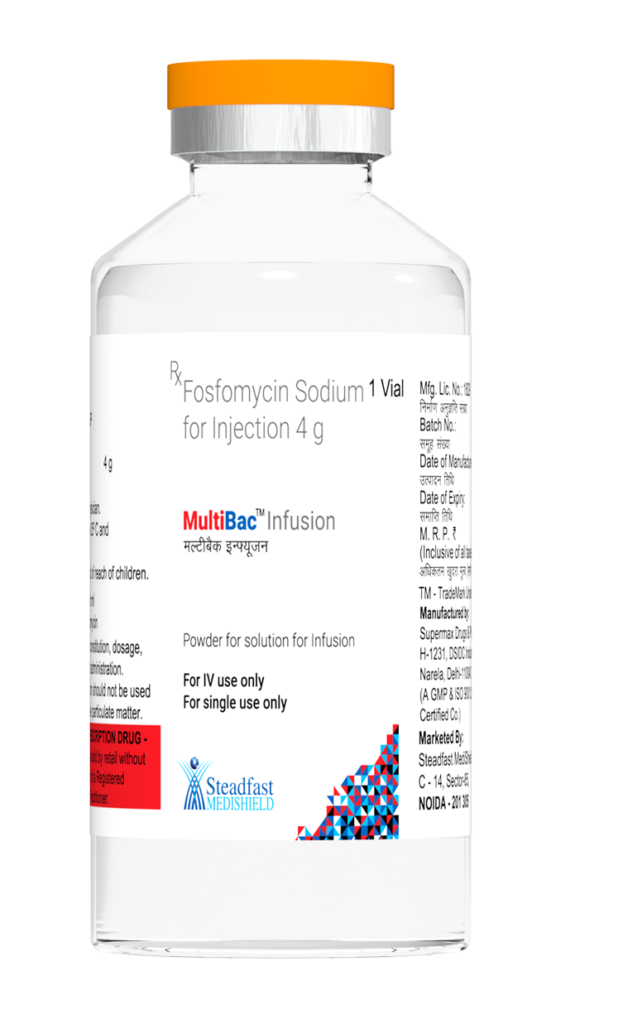
For the use of a Registered Medical Practitioner, Hospital or Laboratory only.
1. Description
MultiBac Infusion contains Fosfomycin Sodium 4 g, a broad-spectrum bactericidal antibiotic belonging to the phosphonic acid derivative class. It inhibits the early stage of bacterial cell wall synthesis.
Fosfomycin Sodium for Injection 4 g
2. Composition
Fosfomycin Sodium 4 g
Each vial contains Fosfomycin Sodium BP equivalent to Fosfomycin 4 g. After reconstitution, each mL contains 40 mg Fosfomycin.
3. Dosage Form
Powder for solution for IV infusion
4. Pharmacology
Drug Class: Antibiotic (phosphonic acid derivative).
Fosfomycin exerts a bactericidal effect on proliferating pathogens by preventing enzymatic synthesis of the bacterial cell wall, inhibiting the first stage of intracellular peptidoglycan synthesis via inhibition of the MurA enzyme, weakening the cell wall and leading to bacterial cell lysis.
Pharmacodynamics
Fosfomycin is a bactericidal, broad-spectrum antibiotic that inhibits bacterial cell wall synthesis at an early stage.
It enters bacterial cells through glycerophosphate (GlpT) and hexose phosphate (UhpT) transport systems. Inside the bacterial cell, fosfomycin irreversibly inhibits the enzyme UDP-N-acetylglucosamine enolpyruvyl transferase (MurA).
MurA catalyzes the first committed step in peptidoglycan synthesis. Inhibition of this enzyme prevents formation of N-acetylmuramic acid, an essential precursor of the bacterial cell wall, leading to bacterial cell lysis and death.
Fosfomycin exhibits concentration-dependent bactericidal activity against many Gram-positive and Gram-negative organisms, including susceptible strains of:
Escherichia coli
Klebsiella spp.
Proteus spp.
Enterococcus faecalis
Staphylococcus aureus (including some MRSA strains)
Pseudomonas aeruginosa (mainly with intravenous therapy)
Its distinct mechanism of action results in minimal cross-resistance with other antibiotic classes, making it useful against multidrug-resistant organisms.
- Broad antimicrobial spectrum against Gram-positive organisms (e.g., MSSA/MRSA Staphylococcus aureus, Enterococcus spp. including VRE) and Gram-negative organisms (e.g., E. coli including ESBL/CRE, Klebsiella pneumoniae, Enterobacterales, variable activity against Pseudomonas aeruginosa).
- High activity against biofilms; synergistic or additive effects with other antibiotic classes; reno-protective effect when combined with nephrotoxic drugs.
- Clinical resistance to fosfomycin remains low.
Pharmacokinetics
Absorption
Administered by intravenous infusion.
Bioavailability is 100%, as the drug is delivered directly into the systemic circulation.
Distribution
Rapidly distributes into extracellular fluid and tissues.
Penetrates well into:
Kidneys
Urinary tract
Bone
Lung
Soft tissues
Cerebrospinal fluid (particularly when meninges are inflamed)
Plasma protein binding is less than 5%.
Metabolism
Fosfomycin is not significantly metabolised.
It circulates primarily as unchanged drug.
Elimination
Eliminated almost entirely by the kidneys through glomerular filtration.
Approximately 90–95% of the administered dose is excreted unchanged in the urine.
Elimination half-life is approximately 1.5–2 hours in patients with normal renal function.
In renal impairment, elimination is prolonged and dosage adjustment is required.
5. Indications
MultiBac Infusion is indicated for the treatment of susceptible bacterial infections, including:
Complicated urinary tract infections
Bloodstream infections (bacteraemia)
Hospital-acquired and ventilator-associated pneumonia
Skin and soft tissue infections
Bone and joint infections
Intra-abdominal infections
Central nervous system infections (as part of combination therapy)
Infections caused by multidrug-resistant Gram-positive and Gram-negative organisms, in accordance with antimicrobial susceptibility results.
MultiBac Infusion is indicated for the treatment of the following infections in adults and children, including neonates, when it is considered inappropriate to use antibacterial agents commonly recommended for initial treatment, or when such agents have failed to demonstrate efficacy:
- Bacterial meningitis
- Bone and joint infection
- Complicated urinary tract infections
- Complicated intra-abdominal infections
- Nosocomial lower respiratory tract infections (HAP/VAP)
- Complicated skin and soft tissue infection
- Infective endocarditis
- Bacteraemia/sepsis associated with the above infections
Fosfomycin is generally recommended for use as part of a combination antibacterial regimen; relevant clinical treatment guidelines should be consulted for selecting an appropriate combination partner. As with all antibacterials, MultiBac Infusion should be used only to treat infections proven or strongly suspected to be caused by susceptible bacteria, guided by culture and susceptibility data where available.
6. Contraindications
Hypersensitivity to fosfomycin or any excipient.
7. Precautions
Adjust dosage in patients with renal impairment.
Monitor serum sodium, especially in patients receiving high doses, as fosfomycin sodium contributes to sodium load.
Monitor electrolyte balance, particularly potassium.
Superinfection with non-susceptible organisms may occur with prolonged therapy.
Use with caution in patients with heart failure or sodium-restricted diets.
Use during pregnancy and lactation only if the expected benefit outweighs the potential risk.
- Risk of sodium overload associated with use — a low-sodium diet is recommended during treatment; potassium supplementation may be required due to risk of hypokalaemia from high sodium load.
- Special caution advised with high-dose regimens (>16 g/day) due to limited safety data.
- Risk of plasma electrolyte imbalance.
- Caution in patients with cardiac insufficiency, hypertension, hyperaldosteronism, hypernatraemia, or pulmonary oedema.
- Pregnancy: no clinical studies available; fosfomycin crosses the placental barrier — use only if benefit to the mother outweighs risk to the fetus.
- Breastfeeding: low quantities found in human milk; not recommended as first choice, especially for premature or newborn infants — weigh developmental/health benefits of breastfeeding against clinical need and potential effects on the infant.
- Paediatrics: limited safety data available; expected adverse-reaction profile similar to adults.
- Geriatrics: no dose adjustment necessary based on age alone; assess renal function and reduce dose if impaired.
- The constituted solution should not be used if it contains any visible particulate matter.
8. Drug Interactions
Concomitant nephrotoxic agents may increase the risk of renal impairment.
Loop diuretics may increase electrolyte disturbances.
No clinically significant cytochrome P450-mediated drug interactions have been identified.
No formal drug–drug interaction studies have been performed with fosfomycin, and to date no clinically relevant pharmacological interactions with other agents (drugs, stimulants, or foodstuffs) have been reported.
- Combination with β-lactam antibiotics (e.g., penicillin, ampicillin, cefazolin, carbapenems): in-vitro data suggest an additive or synergistic effect.
- Combination with most anti-staphylococcal agents (linezolid, quinupristin/dalfopristin, moxifloxacin): similar additive/synergistic pattern in staphylococcal infections.
- Combination with aminoglycosides: predominantly indifferent to additive effects.
9. Adverse Effects
Common adverse reactions include:
Injection site reactions
Nausea
Vomiting
Diarrhoea
Headache
Rash
- Common: electrolyte imbalance (hypokalaemia due to sodium load); GI disturbances (nausea, vomiting, taste disturbance, diarrhoea); local reactions (thrombophlebitis, venous irritation, especially with rapid infusion); allergic reactions (rash, angioedema — rare); mild haematological effects (leucopenia, transient elevated transaminases).
- Rare: anaphylaxis and severe liver toxicity — extremely rare, reported anecdotally over more than 40 years of use.
10. Dosage & Administration
For intravenous use only.
Reconstitute and dilute according to the prescribing information before administration.
The dosage depends on the type and severity of infection, renal function, and the causative organism.
Typical adult dosage ranges from 4 g to 24 g daily, administered in divided doses, as directed by the treating physician
Dosage form: Powder for solution for infusion. Route: For intravenous (IV) use only, administered by a healthcare professional.
The daily dose is determined by indication, severity and site of infection, pathogen susceptibility, and renal function.
|
Indication (adults & adolescents ≥12 yrs, >40 kg) |
Daily dose |
|
Bacterial meningitis |
16–24 g* in 3–4 divided doses |
|
Bone and joint infections |
12–24 g* in 2–3 divided doses |
|
Complicated intra-abdominal / skin & soft tissue infections; complicated UTI; HAP/VAP; infective endocarditis; associated bacteraemia |
Per indication severity, within the 12–24 g/day range in divided doses |
*The high-dose regimen (>16 g/day in 3 divided doses) should be used for severe infections expected or known to be caused by less-susceptible bacteria. Individual doses must not exceed 8 g. Safety data are limited for doses exceeding 16 g/day; special caution is advised.
- Renal impairment: no dose adjustment if CrCl 40–80 mL/min. Patients on chronic intermittent dialysis (every 48 hours) should receive 2 g at the end of each dialysis session.
- Hepatic impairment: no data indicating dose adjustment is necessary.
- Geriatric patients (>65 years): standard adult doses apply; caution advised at the higher end of the dose range.
- Obesity (BMI >38 kg/m²): an increased dosing regimen (16–24 g/day) may be required depending on site and severity of infection.
Neonates, Infants and Children <12 years (<40 kg)
|
Age / weight |
Daily dose |
|
Premature neonates (age† <40 weeks) |
100 mg/kg BW in 2 divided doses |
|
Neonates (age† 40–44 weeks) |
200 mg/kg BW in 3 divided doses |
|
Infants 1–12 months (up to 10 kg BW) |
200–300‡ mg/kg BW in 3 divided doses |
|
Infants & children 1–12 years (10–40 kg BW) |
200–400‡ mg/kg BW in 3–4 divided doses |
†Sum of gestational and postnatal age. ‡The high-dose regimen (>300 mg/kg/day) may be considered for severe infections (e.g., meningitis), particularly when caused by organisms with moderate susceptibility. No dose recommendations can be made for children with renal impairment due to lack of human pharmacokinetic data; no data indicate dose adjustment is necessary in hepatic impairment.
11. Overdosage
Symptoms may include: electrolyte disturbances; gastrointestinal disturbances.
There is no specific antidote for fosfomycin overdosage. Management is supportive, with attention to sodium/electrolyte and fluid balance given the sodium load associated with the sodium salt. Fosfomycin is removed by haemodialysis, which may be considered in significant overdose with renal impairment.
12. Storage
Store below 25°C. Keep out of the reach of children. Protect from direct sunlight.
Store below 25°C and protect from light. Keep out of reach of children.
Additional Information
Additional pharmacokinetic information
- Absorption/Cmax: 1 g IV → Cmax ≈ 44 mg/L; 8 g IV → Cmax ≈ 370–552 mg/L; critically ill patients (8 g) → Cmax ≈ 350–380 mcg/mL. 100% bioavailability by the IV route.
- Distribution: volume of distribution ~0.30 L/kg; excellent tissue penetration (lungs, bone, CSF, wounds, abscesses); CSF levels 20–50% of serum in meningitis; crosses the placenta with low levels in breast milk; negligible plasma protein binding.
- Metabolism: not metabolised; no hepatic metabolism or enterohepatic circulation — considered safe in hepatic impairment.
- Elimination: primarily renal (glomerular filtration); approximately 80–95% of the dose excreted unchanged in urine, mostly within 12 hours; ~50–60% cleared in the first 3–4 hours (if CrCl ≥40 mL/min); after an 8 g IV dose, ~6.4 g is recovered in urine within 48 hours; high urinary concentrations achieved.
- Half-life: ~1.5–2 hours in healthy adults; ~3.6–3.8 hours in critically ill patients.
13. Presentation
MultiBac Infusion – 1 vial: Fosfomycin Sodium BP equivalent to Fosfomycin 4 g, powder for solution for infusion. For IV use only. For single use only.