
For the use of a Registered Medical Practitioner, Hospital or Laboratory only.
1. Description
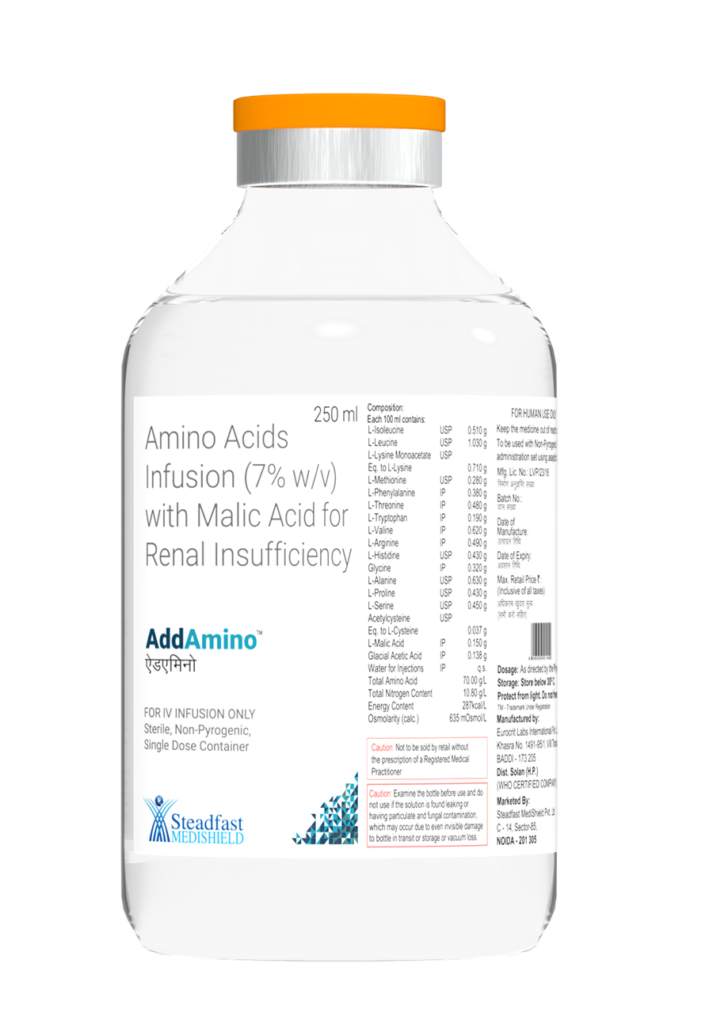
AddAmino IV Infusion is a sterile, non-pyrogenic intravenous amino acid solution intended to provide essential and non-essential amino acids for patients requiring parenteral nutrition when oral or enteral feeding is inadequate, contraindicated, or not feasible.
AddAmino is a clear, sterile, non-pyrogenic injection containing a well-balanced mixture of essential and non-essential amino acids, along with malic acid, which plays a role in energy production and metabolic support. It is prescribed to treat nutritional deficiencies where the enteral route (oral, sublingual/buccal, or rectal) is inadequate, inadvisable, or not possible, and is specifically formulated for the nutritional and metabolic needs of patients with renal insufficiency.
2. Composition
Amino Acids Infusion (7% w/v) with Malic Acid
Each 100 mL contains: L-Isoleucine USP 0.510 g, L-Leucine USP 1.030 g, L-Lysine Monoacetate USP (eq. to L-Lysine 0.710 g), L-Methionine USP 0.280 g, L-Phenylalanine IP 0.380 g, L-Threonine IP 0.480 g, L-Tryptophan IP 0.190 g, L-Valine IP 0.620 g, L-Arginine IP 0.490 g, L-Histidine USP 0.430 g, Glycine IP 0.320 g, L-Alanine IP 0.630 g, L-Proline USP 0.430 g, L-Serine USP 0.450 g, Acetylcysteine USP (eq. to L-Cysteine 0.037 g), L-Malic Acid IP 0.150 g, Glacial Acetic Acid IP 0.138 g, Water for Injections IP q.s. Total Amino Acid 70.00 g/L; Total Nitrogen Content 10.80 g/L; Energy Content 287 kcal/L; Osmolarity (calc.) 635 mOsmol/L.
3. Dosage Form
Intravenous Infusion (IV), 250 mL.
4. Pharmacology
Drug Class: Nutritional Supplement (Parenteral Amino Acid Infusion).
In patients with renal insufficiency, protein metabolism is altered by decreased glomerular filtration rate, impaired nitrogen excretion, and increased catabolism. AddAmino replenishes substrates for protein synthesis, improves nitrogen balance, and counteracts protein-energy wasting (PEW) with a balanced formulation of essential and non-essential amino acids.
Pharmacodynamics
Provides amino acids necessary for protein synthesis, maintenance of positive nitrogen balance, tissue repair, wound healing, and metabolic functions. Amino acids serve as substrates for protein synthesis and various metabolic pathways.
- Substrate for protein synthesis: supports anabolism, muscle mass preservation, and wound healing in PEW.
- Improves nitrogen balance, helping prevent negative nitrogen balance in catabolic states.
- Replaces amino acids lost during dialysis (particularly haemodialysis, where dialysate losses are significant).
- Acetylcysteine content is a stable precursor of L-cysteine, supporting glutathione synthesis and providing antioxidant protection against oxidative stress associated with renal insufficiency.
- Amino acids such as glutamine and alanine act as gluconeogenic substrates, supporting energy production during metabolic stress.
Pharmacokinetics
Absorption
Administered intravenously; therefore, 100% bioavailability.
Distribution
Amino acids distribute rapidly into extracellular and intracellular fluid compartments and are incorporated into body proteins. Distribution volume may be altered by fluid overload or oedema.
Metabolism
Amino acids are utilised for protein synthesis or metabolised primarily in the liver. Excess amino acids undergo deamination with nitrogen converted to urea. Amino acids are metabolised primarily via transamination and deamination in liver and muscle; compromised urea cycle function in renal insufficiency can impair nitrogen processing if dosing is not adjusted.
Elimination
Nitrogen is excreted mainly as urea in urine; minimal unchanged amino acids are excreted by kidneys. Excretion of nitrogenous waste is impaired in renal dysfunction, increasing azotaemia risk. Amino acids are also lost during dialysis, requiring supplementation to maintain balance.
5. Indications
- Parenteral nutrition in patients unable to receive adequate oral or enteral nutrition.
- Prevention or treatment of negative nitrogen balance.
- Nutritional support during surgery, trauma, burns, sepsis, or critical illness.
- Compensation of amino acid losses during dialysis.
- Reduction of protein-energy wasting (PEW) risk in chronic kidney disease (CKD) patients.
- Mitigation of muscle wasting and fatigue in dialysis patients.
- Reduction of oxidative stress and cellular protection.
- Reduction in incidence and severity of cardiac-surgery-associated acute kidney injury (CSA-AKI).
6. Contraindications
- Hypersensitivity to any component.
- Severe disorders of amino acid metabolism.
- Severe hepatic failure with encephalopathy (unless specifically indicated).
- Severe metabolic acidosis not corrected.
- Conditions where parenteral nutrition is contraindicated.
Hypersensitivity to any of the active substances or excipients. Not for use in patients with severe, uncorrected metabolic acidosis.
7. Precautions
- Monitor fluid balance, electrolytes, liver and renal function.
- Use cautiously in renal or hepatic impairment.
- Correct electrolyte abnormalities before administration.
- Monitor serum glucose, acid-base status, and nitrogen balance during prolonged therapy.
- Use with caution in hepatic insufficiency — amino acid solutions may cause serum amino acid imbalances, metabolic alkalosis, prerenal azotaemia, hyperammonaemia, stupor, and coma.
- Monitor acid–base balance, BUN, and electrolytes — periodic laboratory testing is recommended; discontinue if BUN rises above normal postprandial limits and continues to rise.
- Solutions containing acetate ion should be used with care in patients with metabolic or respiratory alkalosis, or with severe hepatic insufficiency where acetate utilisation is impaired.
8. Drug Interactions
No major direct pharmacokinetic drug interactions are reported; however, the clinical interactions listed below should be considered. Compatibility with other IV medications or additives should be confirmed before mixing. Electrolytes, vitamins, and trace elements should only be added when compatibility has been established.
- Corticosteroids/mineralocorticoids: may cause sodium and fluid retention, counteracting intended effects, especially with compromised renal function.
- Diuretics: concomitant use may cause electrolyte imbalances (hypokalaemia, hypomagnesaemia) — monitor and correct.
- ACE inhibitors/ARBs: may increase hyperkalaemia risk when combined, particularly in renal insufficiency.
- Nephrotoxic agents (e.g., aminoglycosides, NSAIDs): concurrent use requires caution, as both can worsen renal function or impair clearance of amino acid metabolites.
- Protein-bound drugs: altered amino acid levels may influence plasma protein binding of drugs such as phenytoin or valproate.
- Tetracycline may reduce the protein-sparing effect of infused amino acids due to its antianabolic activity.
9. Adverse Effects
Nausea, vomiting, fever, chills, infusion-site reactions, thrombophlebitis, electrolyte imbalance, hyperammonemia, hypersensitivity reactions (rare), and metabolic disturbances during prolonged administration.
- Common (mild-to-moderate): nausea, vomiting, headache, mild metabolic acidosis or alkalosis.
- Less common but clinically significant: hyperammonaemia, hypersensitivity reactions, electrolyte disturbances (hyperkalaemia, hyponatraemia), thrombophlebitis at the infusion site, volume overload in patients with cardiac or renal failure.
- Rare: anaphylactic reactions, confusion or stupor, particularly in hepatic insufficiency.
10. Dosage & Administration
Administer intravenously under medical supervision. Dose should be individualised according to body weight, nutritional requirements, age, clinical condition, and laboratory parameters. May be administered through peripheral or central venous access depending on osmolarity and formulation.
Route: For intravenous (IV) infusion only. Dosage: As directed by the physician.
- Acute/chronic renal failure not on dialysis (protein-restricted diet): usual dose 0.5 g/kg/day (≈500 mL/day for a 70 kg adult).
- Renal failure on haemodialysis, haemofiltration, or peritoneal dialysis: dose 1 g/kg/day (≈1000 mL/day for a 70 kg adult).
- Maximum dose: 1.5 g/kg/day (≈1500 mL/day for a 70 kg adult).
- CKD (non-dialysis), where parenteral nutrition is the main protein source: 0.6–0.8 g/kg/day.
To be administered using non-pyrogenic IV administration technique with aseptic precautions.
11. Overdosage
May result in fluid overload, electrolyte disturbances, azotemia, metabolic acidosis, hyperammonemia, or amino acid imbalance. Discontinue infusion and provide supportive treatment.
Excessive or too-rapid infusion may result in nausea, vomiting, fluid/volume overload, electrolyte disturbance, or metabolic acidosis, particularly in patients with hepatic or renal impairment. In the event of overdosage, the infusion should be discontinued and the patient managed symptomatically, with correction of fluid, electrolyte, and acid–base disturbances as required.
12. Storage
Store below 25°C. Protect from light. Do not freeze. Use only if the solution is clear and the container is intact. Use immediately after opening; discard any unused portion — this is a single-use container.
13. Presentation
IV Infusion – 250 mL sterile infusion bottle.