
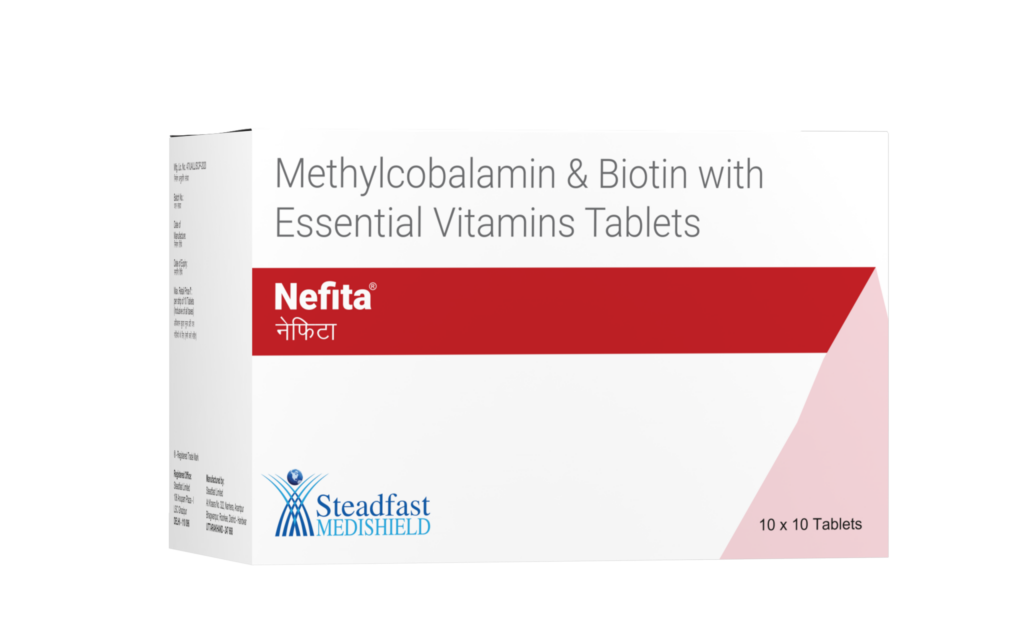
For the use of a Registered Medical Practitioner, Hospital or Laboratory only.
1. Description
Nefita is a multivitamin formulation for the vitamin needs of patients with chronic kidney disease (CKD) and those on dialysis.
2. Composition
Nefita combines various water soluble Vitamins in proportion recommended by NDT. Each tablet contains:
- Vitamin B1 – Thiamine Mononitrate 2 mg
- Vitamin B2 – Riboflavin 3 mg
- Vitamin B3 – Niacinamide 20 mg
- Vitamin B5 – Pantothenic Acid 10 mg (as Calcium Pantothenate IP)
- Vitamin B6 – Pyridoxine HCl 20 mg
- Vitamin B7 – Biotin 300 mcg
- Vitamin B9 – Folic Acid I.P. 10 mg
- Vitamin B12 – Methylcobalamin 1500 mcg
- Vitamin C – Ascorbic Acid 60 mg
- Excipients q.s.
3. Dosage Form
Tablet
4. Pharmacology
Pharmacodynamics
Pharmacological Class: Renal-specific multivitamin supplement; haematinic; neurotropic vitamin preparation.
Nefita Tablets are a combination of water-soluble vitamins specially formulated to meet the nutritional requirements of patients with chronic kidney disease (CKD) and those undergoing dialysis. The formulation helps replenish vitamins that are commonly lost during dialysis and supports erythropoiesis, nerve function, antioxidant defense, and energy metabolism.
The pharmacological actions of the individual components include:
Methylcobalamin (Vitamin B12): Supports DNA synthesis, red blood cell maturation, and myelin formation, promoting normal neurological function and erythropoiesis.
Folic Acid (Vitamin B9): Essential for nucleic acid synthesis and normal red blood cell production; works synergistically with vitamin B12 and helps reduce elevated homocysteine levels.
Pyridoxine (Vitamin B6): Functions as a coenzyme in amino acid metabolism, neurotransmitter synthesis, and heme production.
Thiamine (Vitamin B1): Plays a key role in carbohydrate metabolism and energy production.
Riboflavin (Vitamin B2): Participates in cellular oxidation-reduction reactions and supports energy metabolism.
Niacinamide (Vitamin B3): Precursor of NAD and NADP, essential for cellular respiration and metabolism of carbohydrates, fats, and proteins.
Calcium Pantothenate (Vitamin B5): Required for coenzyme A synthesis and fatty acid metabolism.
Biotin (Vitamin B7): Supports carbohydrate, fat, and protein metabolism.
Ascorbic Acid (Vitamin C): Acts as an antioxidant, supports collagen synthesis, enhances iron utilisation, and protects cells against oxidative stress.
Pharmacokinetics
Absorption
Nefita Tablets are administered orally.
Water-soluble vitamins are readily absorbed from the gastrointestinal tract, primarily in the small intestine, through active transport and passive diffusion depending on the vitamin.
Vitamin B12 (methylcobalamin) absorption occurs through intrinsic factor-mediated uptake in the terminal ileum, while higher doses may also be absorbed by passive diffusion.
Distribution
Water-soluble vitamins are widely distributed throughout body tissues according to physiological requirements.
Methylcobalamin is stored mainly in the liver and distributed to nervous tissue and bone marrow.
Folic acid is concentrated in rapidly dividing tissues.
Vitamin C is widely distributed and reaches high concentrations in metabolically active tissues.
Metabolism
Methylcobalamin functions directly as the active coenzyme form of vitamin B12 and undergoes enterohepatic recycling.
Folic acid is converted to biologically active tetrahydrofolate derivatives.
Pyridoxine is metabolised in the liver to pyridoxal-5-phosphate, its active coenzyme form.
Niacinamide, riboflavin, thiamine, pantothenic acid, and biotin are converted into their respective active coenzymes and participate in normal cellular metabolic pathways.
Ascorbic acid undergoes partial metabolism to inactive metabolites such as oxalate.
Elimination
Excess water-soluble vitamins are eliminated primarily through the kidneys in the urine.
Vitamin B12 undergoes enterohepatic circulation before urinary excretion of excess amounts.
Ascorbic acid and its metabolites are excreted mainly in the urine.
In patients with renal impairment, elimination may be reduced; however, dialysis can remove significant amounts of water-soluble vitamins, necessitating supplementation.
5. Indications
- In the wasting syndrome in chronic renal failure
- Impaired metabolic functions of the kidney
- To maintain levels when the dietary intake of vitamins is inadequate or excretion and loss are excessive
6. Contraindications
- Known hypersensitivity to any component.
- Leber’s disease (hereditary optic nerve atrophy).
- Folic acid should not be used alone in untreated pernicious anaemia or undiagnosed megaloblastic anaemia.
7. Precautions
Folic acid may mask the symptoms of pernicious anaemia in that haematological remission may occur while neurological manifestations remain progressive.
8. Drug Interactions
Do not take this medication with milk, other dairy products, calcium supplements, or antacids that contain calcium. Calcium may make it harder for your body to absorb certain ingredients of the multivitamin.
9. Adverse Effects
When taken as directed, multivitamins are not expected to cause serious side effects. Less serious side effects may include:
- upset stomach
- headache; or
- unusual or unpleasant taste in your mouth
10. Dosage & Administration
Dosage prescribed is one tablet daily or as directed by a physician. If on dialysis, take after treatment. Use this medication as directed on the label, or as your doctor has prescribed. Do not use the medication in larger amounts or for longer than recommended.
Never take more than the recommended dose of a multivitamin. Avoid taking more than one multivitamin product at the same time unless your doctor tells you to. Taking similar vitamin products together can result in a vitamin overdose or serious side effects.
Avoid the regular use of salt substitutes in your diet if your multivitamin contains potassium. If you are on a low-salt diet, ask your doctor before taking a vitamin or mineral supplement.
It is important to take multivitamins regularly to get the most benefit.
11. Overdosage
Overdose symptoms may include stomach pain, vomiting, diarrhoea, constipation, loss of appetite, hair loss, peeling skin, tingly feeling in or around your mouth, changes in menstrual periods, weight loss, severe headache, muscle or joint pain, severe back pain, blood in your urine, pale skin, and easy bruising or bleeding.
12. Storage
Store Nefita at room temperature away from moisture and heat.
13. Presentation
10 tablets in a strip, 10 strips in a Box.